Note
This page is a reference documentation. It only explains the function signature, and not how to use it. Please refer to the user guide for the big picture.
nilearn.image.iter_img
- nilearn.image.iter_img(imgs)[source]
Iterate over images.
Could be along the 4th dimension for 4D Niimg-like object or the 2nd dimension for 2D Surface images..
- Parameters:
- imgs4D Niimg-like object or
SurfaceImage
- imgs4D Niimg-like object or
- Returns:
- Iterator of
Nifti1ImageorSurfaceImage
- Iterator of
See also
Examples
>>> import numpy as np
>>> from nibabel import Nifti1Image
>>> from nilearn.image import iter_img
>>>
>>> # Create dummy 4D image.
>>> affine = np.eye(4)
>>> data = np.ones((3, 3, 3, 2))
>>>
>>> # Set different values for each 3D image in 4D series.
>>> for i in range(data.shape[-1]):
...     data[:, :, :, i] = data[:, :, :, i] * i
>>>
>>> # Create 4D Nifti Image and print the shape of the data.
>>> img_4d = Nifti1Image(data, affine)
>>> f"{img_4d.__class__.__name__} with shape= {img_4d.shape}"
'Nifti1Image with shape= (3, 3, 3, 2)'
>>>
>>> # iter_img creates a generator object.
>>> all_images = iter_img(img_4d)
>>> type(all_images)
<class 'generator'>
>>>
>>> # Let's check its content.
>>> [f"{x.__class__.__name__} with shape= {x.shape}" for x in all_images]
['Nifti1Image with shape= (3, 3, 3)', 'Nifti1Image with shape= (3, 3, 3)']
Examples using nilearn.image.iter_img
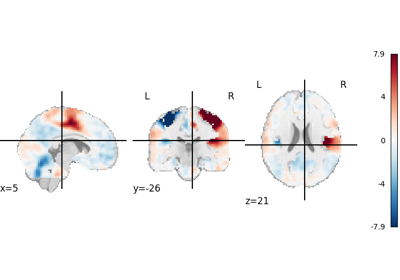
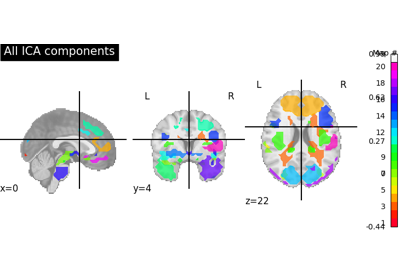
Deriving spatial maps from group fMRI data using ICA and Dictionary Learning
Deriving spatial maps from group fMRI data using ICA and Dictionary Learning