Note
Go to the end to download the full example code. or to run this example in your browser via Binder
Voxel-Based Morphometry on Oasis dataset with Space-Net prior
Predicting age from gray-matter concentration maps from OASIS dataset. Note that age is a continuous variable, we use the regressor here, and not the classification object.
See also
The documentation: SpaceNet: decoding with spatial structure for better maps.
For more information see the dataset description.
Load the Oasis VBM dataset
import numpy as np

from nilearn import datasets

n_subjects = 200
dataset_files = datasets.fetch_oasis_vbm(n_subjects=n_subjects)
age = dataset_files.ext_vars["age"].astype(float)
age = np.array(age)
gm_imgs = np.array(dataset_files.gray_matter_maps)


# Split data into training set and test set
from sklearn.model_selection import train_test_split
from sklearn.utils import check_random_state

rng = check_random_state(42)
gm_imgs_train, gm_imgs_test, age_train, age_test = train_test_split(
    gm_imgs, age, train_size=0.6, random_state=rng
)

# Sort test data for better visualization (trend, etc.)
perm = np.argsort(age_test)[::-1]
age_test = age_test[perm]
gm_imgs_test = gm_imgs_test[perm]
[fetch_oasis_vbm] Dataset directory found: /home/runner/work/nilearn/nilearn/nilearn_data/oasis1
Fit the SpaceNet and predict with it
To save time (because these are anat images with many voxels), we include only the 5-percent voxels most correlated with the age variable to fit. Also, we set memory_level=2 so that more of the intermediate computations are cached. We used a graph-net penalty here but more beautiful results can be obtained using the TV-l1 penalty, at the expense of longer runtimes. Also, you may pass and n_jobs=<some_high_value> to the SpaceNetRegressor class, to take advantage of a multi-core system.
from nilearn.decoding import SpaceNetRegressor

decoder = SpaceNetRegressor(
    memory="nilearn_cache",
    penalty="graph-net",
    screening_percentile=5.0,
    memory_level=2,
    n_jobs=2,
    verbose=1,
)
decoder.fit(gm_imgs_train, age_train)  # fit
coef_img = decoder.coef_img_
y_pred = decoder.predict(gm_imgs_test).ravel()  # predict
mse = np.mean(np.abs(age_test - y_pred))
print(f"Mean square error (MSE) on the predicted age: {mse:.2f}")
/home/runner/work/nilearn/nilearn/examples/02_decoding/plot_oasis_vbm_space_net.py:68: MaskWarning:

Brain mask (7221031.999999998 mm^3) is bigger than the standard human brain (1882989.0 mm^3).This object is probably not tuned to be used on such data.

[SpaceNetRegressor.fit] Mask volume = 7.22103e+06mm^3 = 7221.03cm^3
[SpaceNetRegressor.fit] Standard brain volume = 1.88299e+06mm^3
[SpaceNetRegressor.fit] Original screening-percentile: 5
[SpaceNetRegressor.fit] Corrected screening-percentile: 1.30382
[SpaceNetRegressor.fit] Time Elapsed: 00 HR 01 MIN 47 SEC seconds.
/home/runner/work/nilearn/nilearn/.tox/doc/lib/python3.11/site-packages/joblib/memory.py:607: JobLibCollisionWarning:

Cannot detect name collisions for function 'nifti_masker_extractor'

Mean square error (MSE) on the predicted age: 12.39
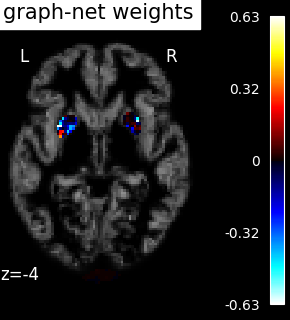
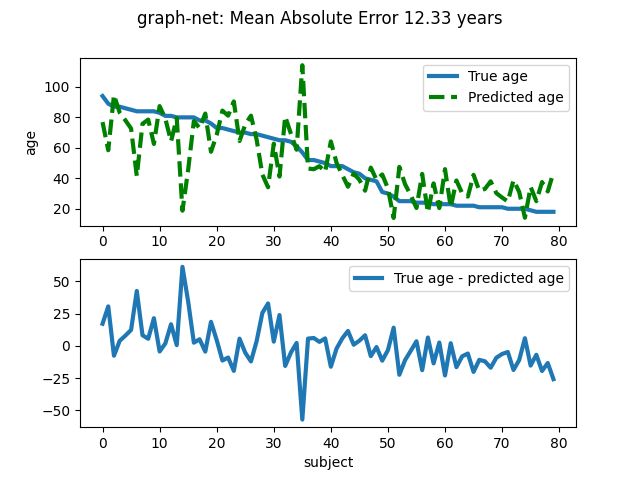
Visualize the decoding maps and quality of predictions
import matplotlib.pyplot as plt

from nilearn.plotting import plot_stat_map, show

# weights map
background_img = gm_imgs[0]
plot_stat_map(
    coef_img,
    background_img,
    title="graph-net weights",
    display_mode="z",
    cut_coords=1,
)

# Plot the prediction errors.
plt.figure()
plt.suptitle(f"graph-net: Mean Absolute Error {mse:.2f} years")
linewidth = 3
ax1 = plt.subplot(211)
ax1.plot(age_test, label="True age", linewidth=linewidth)
ax1.plot(y_pred, "--", c="g", label="Predicted age", linewidth=linewidth)
ax1.set_ylabel("age")
plt.legend(loc="best")
ax2 = plt.subplot(212)
ax2.plot(
    age_test - y_pred, label="True age - predicted age", linewidth=linewidth
)
ax2.set_xlabel("subject")
plt.legend(loc="best")

show()
Total running time of the script: (1 minutes 53.900 seconds)
Estimated memory usage: 2575 MB
