Note
Go to the end to download the full example code. or to run this example in your browser via JupyterLite or Binder
Massively univariate analysis of face vs house recognition
A permuted Ordinary Least Squares algorithm is run at each voxel in order to determine whether or not it behaves differently under a “face viewing” condition and a “house viewing” condition. We consider the mean image per run and per condition. Otherwise, the observations cannot be exchanged at random because a time dependence exists between observations within a same run (see Winkler et al.[1] for more detailed explanations).
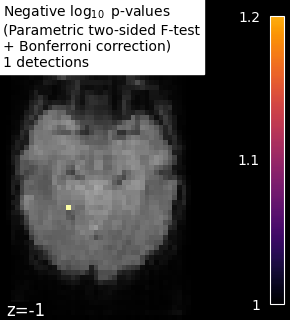
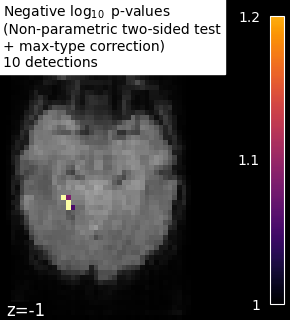
The example shows the small differences that exist between Bonferroni-corrected p-values and family-wise corrected p-values obtained from a permutation test combined with a max-type procedure (Anderson and Robinson[2]). Bonferroni correction is a bit conservative, as revealed by the presence of a few false negative.
Load Haxby dataset
from nilearn import datasets, image
from nilearn.plotting import plot_stat_map, show

haxby_dataset = datasets.fetch_haxby(subjects=[2])

# print basic information on the dataset
print(f"Mask nifti image (3D) is located at: {haxby_dataset.mask}")
print(f"Functional nifti image (4D) is located at: {haxby_dataset.func[0]}")
[fetch_haxby] Dataset directory found: /home/runner/nilearn_data/haxby2001
Mask nifti image (3D) is located at: /home/runner/nilearn_data/haxby2001/mask.nii.gz
Functional nifti image (4D) is located at: /home/runner/nilearn_data/haxby2001/subj2/bold.nii.gz
Restrict to faces and houses
import numpy as np
import pandas as pd

labels = pd.read_csv(haxby_dataset.session_target[0], sep=" ")
conditions = labels["labels"]
categories = conditions.unique()
conditions_encoded = np.zeros_like(conditions)
for c, category in enumerate(categories):
    conditions_encoded[conditions == category] = c
runs = labels["chunks"]
condition_mask = conditions.isin(["face", "house"])
conditions_encoded = conditions_encoded[condition_mask]
Mask data
from nilearn.image import index_img
from nilearn.maskers import NiftiMasker

mask_filename = haxby_dataset.mask

nifti_masker = NiftiMasker(
    smoothing_fwhm=8,
    mask_img=mask_filename,
    memory="nilearn_cache",  # cache options
    memory_level=1,
    verbose=1,
)
func_filename = haxby_dataset.func[0]
func_reduced = index_img(func_filename, condition_mask)
fmri_masked = nifti_masker.fit_transform(func_reduced)

# We consider the mean image per run and per condition.
# Otherwise, the observations cannot be exchanged at random because
# a time dependence exists between observations within a same run.
n_runs = np.unique(runs).size
conditions_per_run = 2
grouped_fmri_masked = np.empty(
    (conditions_per_run * n_runs, fmri_masked.shape[1])
)
grouped_conditions_encoded = np.empty((conditions_per_run * n_runs, 1))

for s in range(n_runs):
    run_mask = runs[condition_mask] == s
    run_house_mask = np.logical_and(
        run_mask, conditions[condition_mask] == "house"
    )
    run_face_mask = np.logical_and(
        run_mask, conditions[condition_mask] == "face"
    )
    grouped_fmri_masked[2 * s] = fmri_masked[run_house_mask].mean(0)
    grouped_fmri_masked[2 * s + 1] = fmri_masked[run_face_mask].mean(0)
    grouped_conditions_encoded[2 * s] = conditions_encoded[run_house_mask][0]
    grouped_conditions_encoded[2 * s + 1] = conditions_encoded[run_face_mask][
        0
    ]
\[NiftiMasker.wrapped] Loading mask from
'/home/runner/nilearn_data/haxby2001/mask.nii.gz'
\[NiftiMasker.wrapped] Loading data from <nibabel.nifti1.Nifti1Image object at
0x7f0c03c455a0>
\[NiftiMasker.wrapped] Resampling mask
\[NiftiMasker.wrapped] Finished fit
/home/runner/work/nilearn/nilearn/examples/07_advanced/plot_haxby_mass_univariate.py:66: FutureWarning:

boolean values for 'standardize' will be deprecated in nilearn 0.15.0.
Use 'zscore_sample' instead of 'True' or use 'None' instead of 'False'.

________________________________________________________________________________
[Memory] Calling nilearn.maskers.nifti_masker.filter_and_mask...
filter_and_mask(<nibabel.nifti1.Nifti1Image object at 0x7f0c03c455a0>, <nibabel.nifti1.Nifti1Image object at 0x7f0c03c45810>, { 'clean_args': None,
  'clean_kwargs': {},
  'cmap': 'gray',
  'detrend': False,
  'dtype': None,
  'high_pass': None,
  'high_variance_confounds': False,
  'low_pass': None,
  'reports': True,
  'runs': None,
  'smoothing_fwhm': 8,
  'standardize': False,
  'standardize_confounds': True,
  't_r': None,
  'target_affine': None,
  'target_shape': None}, memory_level=1, memory=Memory(location=nilearn_cache/joblib), verbose=1, confounds=None, sample_mask=None, copy=True, sklearn_output_config=None)
\[NiftiMasker.wrapped] Loading data from <nibabel.nifti1.Nifti1Image object at
0x7f0c03c455a0>
\[NiftiMasker.wrapped] Smoothing images
\[NiftiMasker.wrapped] Extracting region signals
\[NiftiMasker.wrapped] Cleaning extracted signals
__________________________________________________filter_and_mask - 1.4s, 0.0min
Perform massively univariate analysis with permuted OLS
We use a two-sided t-test to compute p-values, but we keep trace of the effect sign to add it back at the end and thus observe the signed effect
from nilearn.mass_univariate import permuted_ols

# Note that an intercept as a covariate is used by default
output = permuted_ols(
    grouped_conditions_encoded,
    grouped_fmri_masked,
    n_perm=10000,
    two_sided_test=True,
    verbose=1,  # display progress bar
    n_jobs=2,  # can be changed to use more CPUs
)
neg_log_pvals = output["logp_max_t"]
t_scores_original_data = output["t"]
signed_neg_log_pvals = neg_log_pvals * np.sign(t_scores_original_data)
signed_neg_log_pvals_unmasked = nifti_masker.inverse_transform(
    signed_neg_log_pvals
)
[Parallel(n_jobs=2)]: Using backend LokyBackend with 2 concurrent workers.
[Parallel(n_jobs=2)]: Done   2 out of   2 | elapsed:    5.8s remaining:    0.0s
[Parallel(n_jobs=2)]: Done   2 out of   2 | elapsed:    5.8s finished
\[NiftiMasker.inverse_transform] Computing image from signals
________________________________________________________________________________
[Memory] Calling nilearn.masking.unmask...
unmask(array([[0., ..., 0.]]), <nibabel.nifti1.Nifti1Image object at 0x7f0c03c45810>)
___________________________________________________________unmask - 0.0s, 0.0min
scikit-learn F-scores for comparison
F-test does not allow to observe the effect sign (pure two-sided test)
from sklearn.feature_selection import f_regression

# f_regression implicitly adds intercept
_, pvals_bonferroni = f_regression(
    grouped_fmri_masked,
    grouped_conditions_encoded.ravel(),
)
pvals_bonferroni *= fmri_masked.shape[1]
pvals_bonferroni[np.isnan(pvals_bonferroni)] = 1
pvals_bonferroni[pvals_bonferroni > 1] = 1
neg_log_pvals_bonferroni = -np.log10(pvals_bonferroni)
neg_log_pvals_bonferroni_unmasked = nifti_masker.inverse_transform(
    neg_log_pvals_bonferroni
)
\[NiftiMasker.inverse_transform] Computing image from signals
________________________________________________________________________________
[Memory] Calling nilearn.masking.unmask...
unmask(array([-0., ..., -0.]), <nibabel.nifti1.Nifti1Image object at 0x7f0c03c45810>)
___________________________________________________________unmask - 0.0s, 0.0min
Visualization
from nilearn.image import get_data

# Use the fMRI mean image as a surrogate of anatomical data
mean_fmri_img = image.mean_img(func_filename)

threshold = -np.log10(0.1)  # 10% corrected

vmax = min(signed_neg_log_pvals.max(), neg_log_pvals_bonferroni.max())

# Plot thresholded p-values map corresponding to F-scores

neg_log_pvals_bonferroni_data = get_data(neg_log_pvals_bonferroni_unmasked)
n_detections = (neg_log_pvals_bonferroni_data > threshold).sum()
title = (
    "Negative $\\log_{10}$ p-values"
    "\n(Parametric two-sided F-test"
    "\n+ Bonferroni correction)"
    f"\n{n_detections} detections"
)

display = plot_stat_map(
    neg_log_pvals_bonferroni_unmasked,
    mean_fmri_img,
    threshold=threshold,
    display_mode="z",
    cut_coords=[-1],
    vmax=vmax,
    vmin=threshold,
    cmap="inferno",
)

display.title(title, size=10)

# Plot permutation p-values map
n_detections = (np.abs(signed_neg_log_pvals) > threshold).sum()
title = (
    "Negative $\\log_{10}$ p-values"
    "\n(Non-parametric two-sided test"
    "\n+ max-type correction)"
    f"\n{n_detections} detections"
)

display = plot_stat_map(
    signed_neg_log_pvals_unmasked,
    mean_fmri_img,
    threshold=threshold,
    display_mode="z",
    cut_coords=[-1],
    vmax=vmax,
    vmin=threshold,
    cmap="inferno",
)

display.title(title, size=10)

show()
References
Total running time of the script: (0 minutes 16.845 seconds)
Estimated memory usage: 1282 MB

